
The Real Energy War of 2026: Molecules, Logistics, and Geopolitical Stress
Jan 09, 2026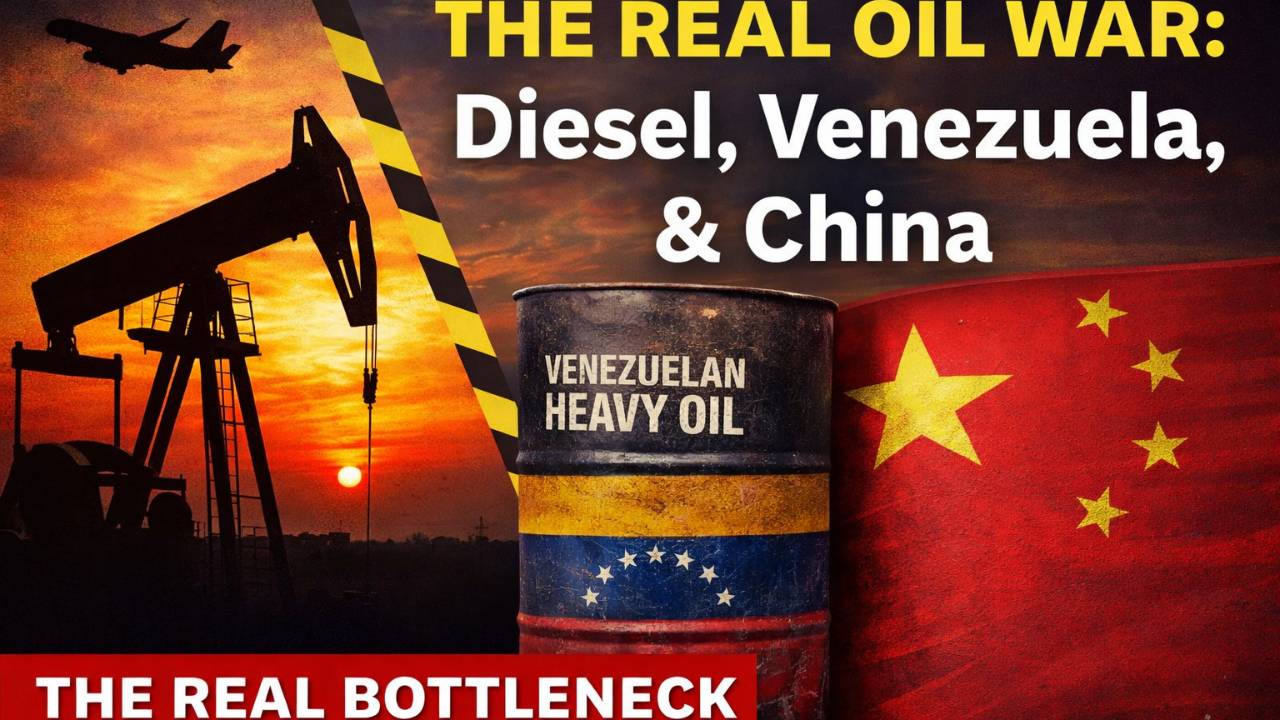
Introduction
As analyzed and highlighted by Michael Burry, global “All Liquids” oil production is at all-time highs. However, this figure is deeply misleading. Most of the recent increase comes from gas and light liquids. What the global system is truly lacking are middle distillates, especially diesel and jet fuel: the energy that moves goods, armies, agriculture, and infrastructure.
This is the real bottleneck of the global economy.
The Chemical Thesis
Oil is not a single product. It is a complex mixture of molecules with different carbon chain lengths, and those lengths determine real economic utility.
Short chains include gas and gasoline. They are abundant and mainly serve civilian consumption.
Medium chains include diesel and aviation fuel. They are essential for industry, logistics, heavy machinery, and warfare.
Very long chains include bitumen and residuals. They are fundamental for roads, ports, airports, and physical infrastructure.
Today, the world is structurally long short chains and structurally short medium chains. This mismatch, not “peak oil”, represents the real fragility of the system.
Why Venezuela, Iran, and Russia Matter
Heavy crude grades, particularly Venezuelan and partly Iranian and Russian, are rich in long-chain molecules. These molecules can be efficiently cracked through coking processes to obtain diesel and jet fuel. Doing the opposite, “gluing” light molecules to produce heavier fuels, is energetically inefficient, costly, and wasteful.
This explains why the type of barrel matters more than the number of barrels.
The Structural Advantage of the United States
Gulf Coast refineries are designed precisely for this scenario: taking heavy sludge and converting it into high-value fuels within a single integrated system. This is not only a technological advantage, but a thermodynamic and logistical one.
The United States can transform the dirtiest and least valuable feedstock into the most strategic products with minimal friction.
China’s Structural Weakness
China does not possess this level of integration. Instead, it relies on a fragmented chain:
Russia and Iran extract.
Venezuela and Canada supply bitumen.
Chinese “teapot refineries” perform the dirty work.
This structure implies long transport routes, thin margins, and permanent geopolitical vulnerability. It is fragile by definition.
China’s true Achilles’ heel is not energy itself, but asphalt.
China consumes enormous quantities of bitumen to sustain its infrastructure buildout. Venezuelan crude is chemically ideal for producing high-quality asphalt. Iranian and Russian grades yield far less. Replacing Venezuelan bitumen would require massive volumes of alternative crude, generating unsustainable waste and destroying refining economics.
The US Strategic Move
By gaining political and logistical control over Venezuelan oil, the United States:
secures optimal feedstock for its refineries;
cuts China off from a critical infrastructure input;
forces Beijing to rely almost exclusively on Iran;
concentrates Chinese risk into a small number of maritime chokepoints.
This is not a conspiracy theory. It is applied biophysics, supply-chain logic, and real geopolitical power. This is why Michael Burry shared this analytical framework.
The Real Geopolitical Framework
This is not a conventional military war. It is a logistical and chemical war. States no longer fight over symbolic territory, but over irreversible bottlenecks: molecules, routes, refineries, and conversion capacity.
Within this framework, Trump often employs strategic deception in communication. The noise is deliberate. The material objectives remain consistent.
Iran: Escalation Possible, Not Excluded
Iran now represents the single point of failure for the Eastern bloc’s access to heavy residual crude.
An escalation cannot be ruled out.
The real objective is not invading Iran, but targeting Kharg Island and export infrastructure. Pressure can be applied through insurance restrictions, shipping enforcement, secondary sanctions, cyber operations, and indirect actions.
A low-intensity escalation scenario, with Israel acting as a proxy and gradual US involvement, is plausible. It is not an extreme scenario.
Growing domestic protests, economic stress, and signals of reduced Russian presence in the region suggest contingency planning is already underway.
The objective is not to destroy the Iranian regime, but to squeeze the system, increasing the fragility of China’s supply chain.
Greenland: Strategic Theater
Greenland is not the objective. It is theater.
It serves to distract media attention while real moves occur in Venezuela, Iran, and energy logistics.
It signals interest in the Arctic, shipping routes, and critical resources.
It reminds Europe of its strategic dependence on the United States.
There will be no invasion. Only signaling.
Market Implications and Macro Stress
Markets are already reacting.
Gold and silver at record highs reflect geopolitical stress and monetary risk.
Oil remains depressed because markets focus on volumes, not quality.
An escalation would quickly invert this structure: oil sharply higher, equities under pressure.
US and European balance sheets show abnormal bullish divergences.
The Japanese 10-year government bond yield is surging, signaling stress in the global rate anchor.
All of this points to a systemic shock, not a standard cyclical recession. In such a context, US yields could collapse, paving the way for a new QE regime.
The United States and Trump
The United States is rebuilding hegemony not through aircraft carriers or narratives, but through:
industrial chemistry;
refining dominance;
energy logistics;
control of critical feedstocks.
Iran becomes the pressure point without a formal declaration of war.
Venezuela becomes the reclaimed strategic asset.
Greenland remains noise.
Crypto Parabola 2025 and What We Expect for 2026
Markets appear increasingly detached from reality, and crypto seems to be the only market following a realistic trajectory relative to global conditions.
We have entered a bear market. Every rebound will likely be absorbed within weeks, or even days. Selling pressure remains dominant, and retail confidence has been structurally damaged.
In 2025, we identified three distinct phases and treated them as opportunities: the January drop, the April local bottom, and the transition into a bear market between September and October. Exiting at the right moment is also an opportunity correctly captured.
All that remains is to observe how 2026 unfolds, and to be ready to recognize and seize the opportunities it will offer.
This article outlines the structural forces shaping energy markets, geopolitics, and global liquidity.
Noodles Research translates these macro dynamics into actionable insight for crypto and digital-asset investors.
