
This Is Not a Crash — It’s a Systemic Deleveraging
Feb 05, 2026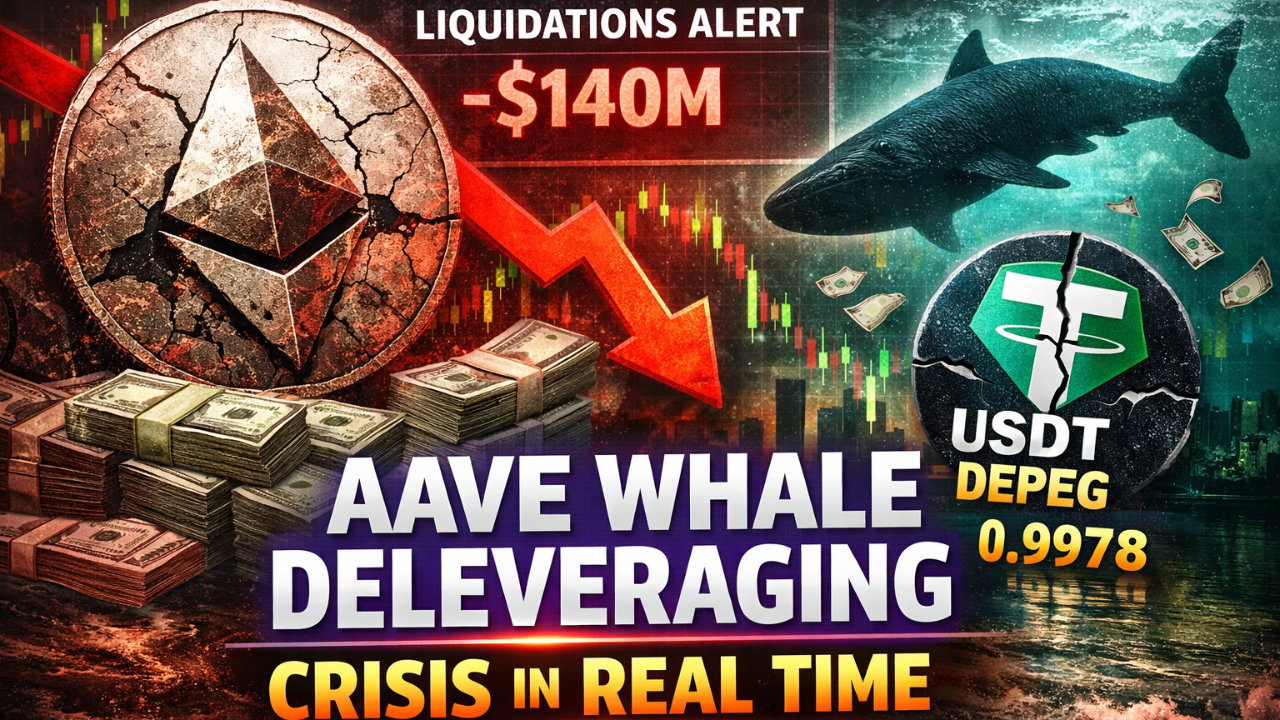
deleveraging, with institutional whales unwinding positions worth hundreds of millions as the market drops. The on-chain data is unambiguous.
Aave — Whale Deleveraging in Real Time
Between February 1–2, two of the largest ETH holders on-chain dumped a combined $371M in ETH to repay Aave loans.
BitcoinOG (1011short) deposited 121,185 ETH ($292M) into Binance and withdrew $92.5M in stablecoins to pay down debt. Trend Research — an affiliate of LD Capital — sold 33,589 ETH ($79M) and repaid 98% of its Aave loan. This is the same firm that had borrowed up to $958M in stablecoins from Aave to go leveraged long ETH at ~$3,265. Their founder had publicly called for a structurally bullish Q1 2026. They are now unwinding.
On January 31 alone, Aave processed over $140M in automated liquidations across multiple networks. This was forced — collateral values dropped below thresholds and positions were closed automatically. The $371M whale deleveraging that followed was voluntary — proactive decisions to sell before reaching liquidation. Both happened within the same 48-hour window.
Ethereum Transactions — All-Time Highs During a Price Collapse
Ethereum just hit a record 2.88M daily transactions (January 16), with the 7-day average near 2.5M — nearly double the levels from the same period in 2025. But here's the key: ETH price has collapsed from ~$4,000 to ~$2,100 while this is happening.
Record transaction volume during a price crash is not bullish adoption. According to Standard Chartered data, 35–40% of all Ethereum transactions are now stablecoin transfers. This is capital flight — liquidations, loan repayments, DeFi position unwinding, and transfers to exchanges for selling.
USDT — Structural Depeg Under Stress
USDT is trading at 0.9978, the most persistent depeg since FTX. This is not a temporary blip. Tether's redemption fee (0.1%) and $100K minimum mean USDT is effectively redeemable at $0.999 — and only for institutional clients. For everyone else, the only exit is selling on exchanges. When everyone sells at once, the peg breaks.
Meanwhile, stablecoin flows to exchanges have collapsed. Net inflows went from +$9.7B/month in October to -$4B recently, with $3.1B in outflows from Binance alone.
USDe / Ethena — The Hidden Risk in the System
Aave governance hardcoded USDe's price to USDT to prevent liquidation cascades. In practice, this means if USDe depegs, liquidations won't trigger — but lenders are left holding undercollateralized loans with no corrective mechanism. The risk hasn't been eliminated. It's been transferred to stablecoin lenders who don't know they're holding it.
USDe already dropped to $0.65 on Binance during the October 10 crash. On-chain it held, but the OKX CEO publicly blamed Binance's USDe yield campaign for triggering the entire liquidation cascade.
The Interconnected Risk Map
Here's how the dominoes fall:
ETH drops → leveraged Aave positions approach liquidation → whales sell ETH to repay → more downward pressure on ETH → selling pressure stresses USDT peg → USDT weakness questions USDe (hardcoded to USDT on Aave) → hidden risk for lenders → liquidity exits exchanges → order books thin out → moves get amplified.
What This Means
This isn't panic selling by retail traders. This is coordinated institutional deleveraging. The whales are reducing exposure, paying down debt, and exiting positions before forced liquidations hit. When the smart money moves this aggressively, it's not a dip — it's a structural shift.
Watch the on-chain data. The story is all there.
Sources
- BeInCrypto: Ethereum Whales Dump to Repay Aave Debt
- Bankless Times: Ethereum Whales Sell $371M
- The Block: Ethereum Daily Transactions Surge to ATH
- Daily Forex: Ethereum Transactions Hit ATH
- Etherscan: Transaction Chart
- DailyCoin: Stablecoin Flows Collapse
- BPI: Stablecoin Risks Warning Bells
- 21Shares: USDe Stability Analysis
- CCN: Ethena USDe Depeg Explained
- Yahoo Finance: Bitcoin Slides Below $80K
- CoinDesk: Bitcoin’s Weekend Crash Exposes Cracks
- CoinDesk: Crypto’s $19B Nightmare
- CryptoSlate: First US Bank Collapse of 2026
The Bottom Line
We said 2026 would bring a systemic liquidity crisis — and it’s unfolding in real time. The greed of certain funds and big players, Bitcoin treasury firms, excess confidence, and permabullish bias are setting the stage for a crisis event — or potential systemic insolvencies, as every bear market eventually delivers.
This is a feedback loop, not a correction.
The question now is whether this deleveraging remains orderly — or whether one of these major players reaches the point of no return.
Stay alert.
━━━━━━━━━━━━━━━━━━━━━━━━━━━━━━
Join the Noodles Research Community
Real-time crypto research, on-chain analysis, and market insights. Stay ahead of the market. Join the conversation.
This article outlines the structural forces shaping energy markets, geopolitics, and global liquidity.
Noodles Research translates these macro dynamics into actionable insight for crypto and digital-asset investors.
